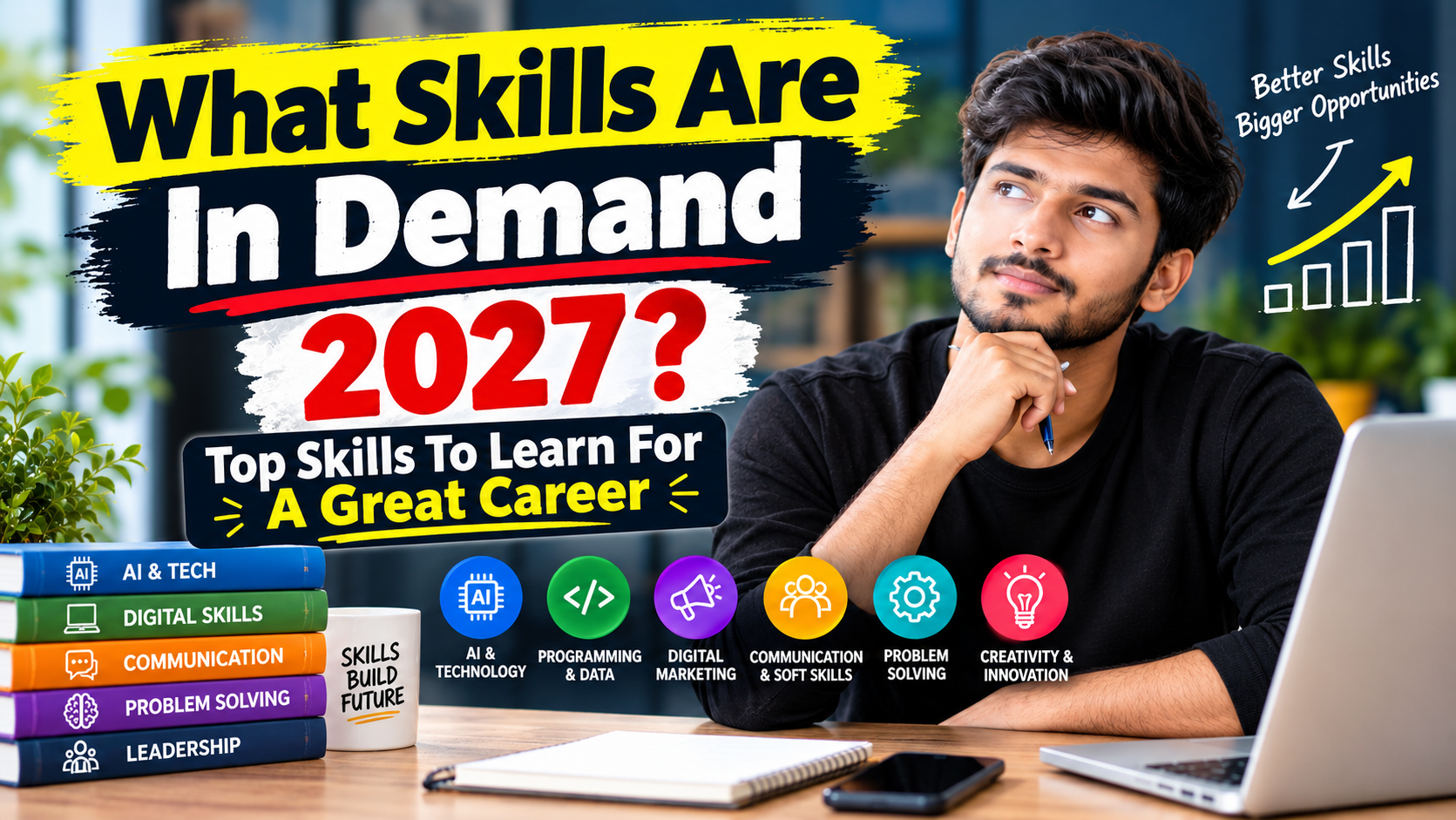
Most in-demand skills in 2027 such as AI, data analysis, digital marketing, communication, cybersecurity, etc. Learn which skills you should acquire for a great career.
Introduction
The job market is undergoing a paradigm shift due to artificial intelligence, digitization, automation, and disruptive business models. Enterprises are now prioritizing skill-based hiring to fill vacant positions with professionals who can bring innovation to the table.
Whether they are students, freshers, job hunters, or experienced professionals, everyone wants to upskill and reskill to stay ahead in their career growth journey. But what skills should one learn and how to begin with it?
In this informative guide, we will discuss which skills are in-demand in 2027, their importance, and how one can go about learning them.
1. Artificial Intelligence (AI) Skills
Artificial intelligence is set to empower education, business operations, content creation, and coding in 2027. It helps create solutions to complex problems while shortening the time taken to finish any given task.
Skills To Learn:
- Using AI tools such as chatGPT and Google Gemini
- Prompt engineering
- AI Research and content creation
- AI Automation
- Accuracy checks on AI data
Careers: AI content specialist, AI automation assistant, AI researcher, and AI-enabled careers in multiple sectors.
How To Start: Learn the fundamentals of AI, practice using AI tools, and create showcase projects that demonstrate your ability to use AI to solve real-world problems
2. Data Analysis
Organizations are using data analytics to transform raw information into meaningful insights that can help improve business processes, better understand their target market, and gain an overall competitive advantage.
Skills To Learn:
- Microsoft Excel and Google Sheets
- SQL Fundamentals
- Power BI/Tableau
- Statistics
- Cleaning and Visualization
Careers: Data Analyst, Reporting Analyst, Business Analyst, andJunior Data Analysts.
How To Start: Learn Excel and Google Sheets, master statistical concepts and formulas, and develop Pivotal tables. After that, you can move on to learning SQL and Power BI or Tableau and start creating dashboards using publicly available data sets
3. Digital Marketing And SEO
Digital marketing helps organizations connect with their target audience through search engines, websites, and social media. SEO is a vital component of digital marketing that involves optimizing web content to rank higher on search engine results pages.
Skills To Learn:
- SEO
- Keyword research
- Content marketing
- Social media marketing
- Google Analytics and measurement
- Email marketing
Careers: SEO Executive, Digital Marketing Executive, Content Marketer, and Social Media Manager.
How To Start: Set up a website or blog, start with keyword research, create blog posts, and learn how to use Google Analytics to track website traffic.
4. Communication Skills
Strong communication skills are vital in almost all professions. Most employers are looking for individuals with excellent verbal and written communication skills, good presentation skills, active listening, and the ability to collaborate effectively.
Skills To Learn:
- Spoken English and conversational skills
- Effective business writing
- Presentations skills
- Listening skills
- Interview skills
- Teamwork and collaboration
Careers: Communication skills are required in careers such as sales, customer service, management, teaching, technology, and many other fields.
How To Start: Practice speaking English for at least 10-15 minutes daily. Read more and improve your vocabulary. Additionally, you can also practice mock interviews to develop strong interview skills.
5. Coding And Software Development
Coding enables you to build digital solutions, websites, and software. While AI tools are useful in generating code, strong coding skills can benefit you in a myriad of ways such as landing a remote developer job, building your own apps, and freelancing.
Skills To Learn:
- HTML & CSS
- JavaScript
- Python
- Git & GitHub
- Databases
- Debugging
Careers: Web Developer, Software Developer, Junior Python Developer, and Application Developer.
How To Start: Choose which programming language or web development you want to specialize in and start building projects. Some of the first projects you can build include a portfolio, calculator, and a to-do list application.
6. Cybersecurity
With the rising reliance on digital systems, cybersecurity has become a top priority for enterprises. Cybersecurity skills are in high demand as they help secure networks, systems, and sensitive data from cyber attackers.
Skills To Learn:
- Networking basics
- Linux fundamentals
- Account and password security
- Security monitoring and threat detection
- Risk management
- Ethical hacking in legal hacking labs
Careers: Security Analyst, IT Security Support, SOC Analyst, and other cybersecurity-related careers.
How To Start: Learn computer networking and Linux fundamentals and practice in a legal ethical hacking laboratory. You can also learn about the common online security threats and how to protect computer systems.
7. Video Editing
Businesses are utilizing video content for marketing, customer engagement, and education. This means there is a high demand for video editors who can help edit and publish videos on the best platforms.
Skills To Learn:
- Video editing
- Storytelling
- Thumbnail designing
- Sound editing
- Short video editing
- Motion Graphics
Careers: Video Editor, Content Creator, YouTube Editor, and Social Media Content Specialist.
How To Start: Practice video editing using DaVinci Resolve or another video editing tool. You can also begin by publishing some of your short-form videos and showcasing your video editing skills.
8. Graphic Design, UI/UX
Graphic design and UI/UX design play a critical role in helping organizations stand out from their competitors by grabbing the target audience’s attention and convincing them to buy a product or service.
Skills To Learn:
- Graphic Design
- Layout & typography
- Color and design
- Figma
- UI/UX design
- Web design
Careers: Graphic Designer, UI Designer, UX Designer, and Digital Design Assistant.
How To Start: Learn the fundamentals of graphic design and start working on some of the best free design tools such as Canva and Figma. You can begin by creating some of the best-selling poster designs and website mockups.
9. Sales, Business, and Problem-Solving Skills
While technology is important, businesses also require individuals with strong sales skills, business acumen, customer relationship management, and problem-solving abilities.
Skills To Learn:
- Customer relationship management
- Sales
- Communication
- Critical thinking
- Decision making
- Planning
Careers: Sales Executive, Business Development Associate, and Customer Success Associate.
How To Start: Learn how to sell products and services and practice problem-solving techniques such as analyzing simple real-world problems and coming up with cost-effective solutions. Additionally, you can also begin learning how to create simple project proposals.
10. Financial Literacy & Accounting Skills
Becoming financially literate can help you make sound financial decisions in your personal life and can also open the door to a wide range of career opportunities.
Skills To Learn:
- Financial literacy
- Budgeting
- Accounting
- Excel
- Profit and Loss
Careers: Accounts Assistant, Finance Operations Assistant, Bookkeeper, and various other careers that require financial literacy.
How To Start: Learn the basics of accounting, Excel, financial literacy, and budgeting. You can also consider getting certifications if you are considering a career in finance-related fields
Which Skills Should Students And Freshers Learn First?
While it might be tempting to learn everything at once, the best approach is to identify which skills to learn based on your individual interests, current skill level, academic background, and career aspirations.
Students And Freshers Targeting Government Jobs Should Learn: English, Reasoning, QA, Computer Fundamentals, etc.
Students And Freshers Targeting Private Jobs Should Learn: Communication, Excel, Problem-solving, and Other Job Specific Skills
Students And Freshers Wanting To Learn Coding/Programming Should Learn: AI, Databases, and Coding
Students And Freshers Wanting To Learn Blogging Or Freelancing Should Learn: SEO, Content Writing, AI Tools, and Digital Marketing
Students And Freshers Wanting To Learn Content Creation Should Learn: Video Editing, Graphic Design, And Thumbnail Designing
Students And Freshers Interested In Data Analysis Careers Should Learn: Excel, SQL, Statistics, and Power BI
Students And Freshers Wanting To Learn Sales, Business, And Problem-solving Should Learn: Communication, Negotiation, And Customer Management
Students And Freshers Wanting To Learn Accounting And Finance Skills Should Learn: Budgeting, Accounting, And Excel
Technical Skills Vs Soft Skills Which Is More Important?
Both technical and soft skills are important, though the relevance of each skill type depends on the job description.
Technical skills enable one to carry out specific tasks such as data analysis, video editing, website coding, and digital marketing.
On the other hand, soft skills such as good communication, listening, and presentation abilities enable an individual to have a positive attitude and good behavior that can boost one’s productivity at work.
For a successful career, it is important to have a combination of both technical and soft skills.
While it is important to have a technical skill such as Excel, it is also important to know how to present data insights in a professional manner.
Therefore, it is important to prioritize one primary technical skill and a soft skill such as communication or problem-solving.
How To Learn In-Demand Skills For Free
Here is a comprehensive guide on how one can master new skills on a budget.
Step 1: Decide on Which Skill You Want To Learn
Step 2: Find The Best Free Resources
Step 3: Practice Daily For At Least 30 Minutes
Step 4: Build Showcases And Projects
Step 5: Create A Portfolio
Step 6: Seek Feedback
Step 7: Get Internship Or Job Opportunities
Once you have completed any training program, it is important not to stop there but to seek ways that you can apply the new skills you have acquired. This is one of the best ways to ensure continuous improvement.
A Simple 90-Day Skill Development Plan
Here is a simple 90-day skill development plan that can help you make the most out of your learning journey.
Days 1-30: Learn The Basics Of The Chosen Skill
Here are some of the things you should do during the first 30 days of your skill development journey.
- Pick a skill and begin by mastering the fundamentals.
- Watch a good beginner-friendly course and practice for at least 30 to 60 minutes per day.
- Take notes and complete the practice exercises provided in the course.
Days 31-60: Practice The Skill Using Practical Projects
Here are some of the things you should do during the second month of your skill development journey.
- Spend 30 minutes to an hour completing the practical exercises.
- Complete two or three practice projects.
- Finish your first independent project
- Learn the common errors made when using the skill and how to avoid them.
- Learn the most popular tools used in the field.
Days 61-90: Showcase Your Masteries And Get Job Opportunities
Here are some of the things you should do during the third month of your skill development journey.
- Complete a single project and ensure that it is up to standard.
- Document your findings and showcase your projects.
- Create a resume or portfolio that can help when submitting applications for freelance jobs, internships, and entry-level positions. Begin looking for relevant job opportunities.
The time it takes to acquire new skills depends on the initial skill level, the amount of practice done daily, and the complexity of the chosen skill. Some specializations such as medicine and law require years of study to become fully proficient.
However, if you are looking to learn the fundamental concepts and apply them practically, you can achieve that within a short time.
Common Mistakes To Avoid While Learning New Skills
Here are some of the most common mistakes that one should avoid when learning a new skill.
- Avoid learning multiple skills at the same time.
- Avoid watching tutorials without practicing.
- Avoid picking a skill just because it is trending.
- Avoid neglecting soft skills.
- Avoid looking for well-paying jobs immediately after completing a short-term training program.
- Avoid skill-padding: Only list skills that you are confident about on your resume.
- Avoid failing to update your skills throughout your career.
Conclusion
Some of the best skills to learn and invest your time mastering in 2027 include artificial intelligence, data analysis, digital marketing, communication, cybersecurity, software development, video editing, design, business problem-solving, and financial literacy.
However, the choice of the best skill to learn depends on your unique needs and objectives.
The best thing about acquiring new skills is that you do not have to learn everything at once but can instead pick one skill and master it while leaving the rest for later. Once you have mastered one skill, you can move on to the next one.
The most important thing is that you should not simply acquire new skills but rather find out how to apply the skills to solve real-world problems. This way, you will have a solid foundation of experience and the ability to deliver whenever needed.
Final Word
Top skills in demand in 2027 such as AI, data analysis, digital marketing, communication, software development, cybersecurity, video editing, design, business problem-solving, and financial literacy skills are important and everyone should consider learning them
However, the best skill to learn will be determined by personal preferences, academic background, and work experience
Once you have identified the best skill to learn, it is important to find out how to acquire the skill, master it and apply it to real-world problems to gain a significant amount of experience.
No responses yet